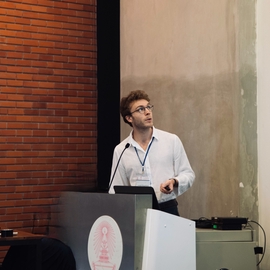
I am an Albert O. Hirschman Postdoctoral Fellow at the Kiel Institute for the World Economy in Berlin.
My research spans political economy, public finance, development, and growth. I use applied methods, economic theory, and historical data to address issues fundamental to long-run development, including state-building and tax resistance, and structural and demographic change.
I completed my PhD at the Center for Economic Research within the École normale supérieure de Lyon. During my PhD, I was a research fellow at the University of Bologna as part of the ERC GENPOP (2024-2026), a Visiting Research Fellow at Brown University (2025), and I visited the University of Chicago Harris School, the University of Oxford, and the Ludwig Maximilian University of Munich.
My job market paper examines the political consequences of tax enforcement. You can also read my research statement.
Job Market Paper
The Political Costs of Tax Enforcement, with Eva Davoine and Igor Kolesnikov.
CESifo Working Paper, EU Tax Observatory Working Paper, SSRN Working Paper.
Presented at the NBER Summer Institute (Political Economy). International Institute of Public Finance PhD award. Finalist for the CESIfo Distinguished Affiliate Award (Public Economics).
Abstract
This paper investigates how popular resistance constrains the development of fiscal capacity in emerging states. We focus on efforts to enforce the early modern French salt tax, the rate of which varied across regions. Using a spatial difference-in-discontinuities design, we compare municipalities just inside the high-tax region with those just outside, before and after a reform aimed at curbing illicit salt smuggling. We find that tax enforcement led to an approximately sevenfold increase in conflicts related to salt smuggling in municipalities in the high-tax region. These effects persist until the French Revolution, supporting the view that enforcing the salt tax incurred significant political costs. Finally, we document that the likelihood of conflict increases with tax differences between neighboring regions, which we use to quantify the costs of enforcing the salt tax at counterfactual rates, and to derive a political Laffer curve.
Presentations
EHA 2022 (single-authored poster), SDU HEDG Workshop, EHS, LMU Student Seminar, York 'Cities and the Wealth of Nations' Workshop, FRESH Louvain, ASREC Europe, LSE Economic History graduate seminar, Carlo Alberto Workshop, CESifo Political Economy Dresden, Bologna Internal Seminar, CEPR Paris Symposium (poster), CEPR Applied Microeconomic History workshop, CESifo Public Economics Conference, CEPR Economic History Symposium, Brown Growth Breakfast, Brown undergraduate lecture, King's College QPE workshop, RIDGE historical development workshop.
Publications
Mapping the Grandes Gabelles in Early Modern France, with Eva Davoine, Victor Gay and Igor Kolesnikov. Explorations in Economic History, vol. 102 (2026), 101785. Published version, TSE Working Paper, HAL open access
Abstract
The gabelle salt tax system was a cornerstone of the fiscal apparatus of the early modern French state. This article introduces a novel historical geographic information system (GIS) of this institution's spatial organization as of the seventeenth century, drawing on an original 1665 manuscript map collection: Sanson's Atlas des gabelles. Beyond presenting the dataset and documenting its construction methodology, we provide a detailed account of the functioning of the gabelle, situate the French case in comparative perspective, and illustrate how the availability of this fine-grained dataset expands the possibilities of empirical research in economic history, historical demography, and historical political economy of early modern France.
Presentations
ENCHOS and Valencia Population Workshop 2025.
Drafts
Malthus in the Raj: The Demographic Limits to State-Led Development, solo-authored.
Abstract
I study how population dynamics constrained state capacity and development in colonial India, using a new annual district-level panel of real wages and vital statistics for roughly 200 districts, 1870–1930. Agricultural real wages show no trend growth over the period, with wages rising above subsistence only after independence, while regional inequality was large and persisted until the 1960s. I show that Malthusian fundamentals and colonial institutions jointly explain these patterns. The land–labor ratio accounts for up to 30 percent of cross-district wage variation. Where the land frontier was open, higher wages increased fertility, and subsequent population growth pushed wages back down. Colonial institutions mediated these dynamics: wage convergence appears only in areas with relatively non-extractive land tenure. Colonial infrastructure investments provide a direct test of the demographic limits to state-led development. In a staggered adoption difference-in-differences setting, I find that railways initially raise real wages by about 18 percent and irrigation works by 12 percent, but these effects fade within roughly 25 years as demographic adjustment absorbs the gains before they can fund structural transformation. Punjab's canal colonies, irrigation settlements that converted over five million acres of wasteland into farmland, illustrate the mechanism: population growth absorbed the land expansion, and the land–labor ratio reverted over time.
Presentations
WEHC 2022, AHEC Bangkok 2022, ADRES 2023, EHS 2023 (poster), Oxford ESH Graduate Seminar, Lewis Lab Graduate Workshop, LORDE 2023, ENS Lyon-Bologna Workshop 2023, IEA Belgrade.
Extraction or Evasion? The Limits of Coercive State-Building, with Eva Davoine and Victor Gay.
Abstract
This paper provides novel historical evidence and quantification of tax evasion in the early modern period, using the case of the French salt tax (gabelle). Tax rates varied substantially across regions, creating incentives for smuggling from low-tax to high-tax areas. Using a novel dataset of salt prices, sales, and enforcement across 249 greniers à sel (salt granaries) in 1665 and 1785, we exploit variation in smuggling incentives, captured by proximity to low-tax regions and cross-border price differentials, to estimate counterfactual sales and revenues absent evasion. We find that evasion reduced voluntary sales by 13% in 1665 and 14% in 1785, with rates exceeding 50% in greniers near the borders with low-tax regions. We decompose net revenue losses into three components: direct evasion, tax rate adjustments, and enforcement costs. By 1785, the state strategically deployed enforcement and lowered salt prices where smuggling pressure was highest. Yet these responses proved costly: net revenue losses increased from 12% to 18%, as both enforcement costs and revenue losses from tax rate adjustments rose as shares of counterfactual revenue.
Presentations
EHES 2025, French Economic History Online Seminar, Cambridge Economic History Seminar.
Grounded Ideologies: Soil Permeability, Human Settlement, and Political Preferences, with Étienne Le Rossignol.
Presentations
ASREC Europe 2026.
Ongoing Research
The Race Between Lewis and Malthus: Differential Fertility and Structural Transformation.
Presentations
LAGV 2023, World Cliometrics 2023, INET Mumbai 2024, Bologna GENPOP seminar, AHEC Hong-Kong.
Genealogies. With Nicola Barban, Thomas Baudin, Guillaume Blanc, Matthew Curtis, Paula Gobbi, Simone Moriconi, and Robert Stelter.
Presentations
Vienna CSH AI workshop.
Taxation, Specialization, and the Formation of Cultural Traits. With Eva Davoine and Étienne Le Rossignol.
Global Human Development Over Five Millennia: Evidence from Expert Elicitation. With Jean-Pascal Bassino.
Rooted in Place: Staple Crops, Trade and Structural Transformation. With Jonathan Dries and Calumn Hamilton.
Other Research
Expand
Military Registers Project, with Killian Barrère, Cédric Chambru, Guillaume Daudin and Alexis Litvine.
More
Developing new machine learning tools for the automated recognition of archival documents, we construct an individual database of French soldiers for the 18th and 19th century, which will be foundational to answer a range of questions related to state capacity and development.World Military Capacity Database, with Kpêdido Godonou.
More
Development of a LLM-based API for automated construction of a database of military conflicts extracted from multilingual Wikipedia. Presented at EHES 2023.The Reproducibility and Robustness of Economics and Political Science by Method and Field, with Abel Brodeur (corresponding author) et al., 2026.
I4R Replication Report of “How Merchant Towns Shaped Parliaments: From the Norman Conquest of England to the Great Reform Act” (Angelucci et al., 2022), with Cédric Chambru, Thibaut Mirabel & Bastien Tourenc, 2024.
Un outil pour la délibération fiscale : l’impôt abc, with Gaël Giraud, Éric Levieil and Mathilde Salin, 2021.
More
Note de l'Institut Rousseau (policy paper). Presented at the Georgetown EJP Seminar (slides). Xerfi Canal interview.The Measure of Disorder: Population, State-Building and Rebellion in Old Regime France, master’s thesis, 2020. Slides. Supervisor: Thomas Piketty.
Teaching
References
Contact
Email is the best way to reach me.
- Joseph.Enguehard [at] ifw-kiel.de